Family Court Records in Seminole County provide an official snapshot of divorce, custody, support, and adoption filings. The Clerk’s online portal lets you perform a Seminole County family court case lookup by name, case number, or filing date. Fees start at $2 per year searched, with additional costs for certified copies or e‑certification. Requests can be made online, by mail, or in person at the Clerk’s office on Bush Blvd.
Family Court Records search results reveal the docket, hearing logs, and final judgments for each family law case. Common document types include petitions, motions, protective order records, and child support orders that shape a family’s legal landscape. If a record is sealed, only authorized parties may request a copy through the Seminole County family court clerk with proper ID. Typical turnaround time for certified copies ranges from same‑day pickup to three business days for mailed requests.
How to Search Family Court Records
Family Court Records in Seminole County are official case files involving divorce, child custody, child support, adoption, and related family matters. A Seminole County family court case lookup and felony records can locate a case number, filing date, docket activity, hearing records, and orders connected to a named party. The results show what appears in the court file, but the most recent written order or judgment should be checked before relying on the legal result. Use the Clerk’s official search system to begin, then follow its stated process for viewing, purchasing, or requesting a copy.
Official Search Portal: https://www.seminoleclerk.org
Steps to Search
- Open the official Seminole County Clerk website and follow its court-records or official-records search option.
- Select Family Court or the closest family-law case category shown on the search page.
- Enter a party’s full legal name or an exact family court case number. Add a filing-date range when it helps narrow the results.
- Open each matching case and compare the case number, case title, filing date, and assigned judge before choosing a record.
- Use an available download or copy option and pay any listed charge. If a document is missing or access is limited, follow the official copy-request process instead of relying on a search preview.
Family Court Record Types, Petitions, and Judgments
A family case begins with a qualifying filing in the Seminole County family division. The case docket acts as a chronological index, while petitions, motions, hearing logs, orders, and judgments are separate records created within the case. Knowing what each record does helps a searcher distinguish a filing event from the court’s final decision or the terms currently in force.
Divorce, Dissolution, Custody, Support, and Adoption Filings
Divorce and dissolution of marriage are related labels used in family cases. A case can also include disputes over parental responsibilities, parenting time, property division, or support. The Clerk’s docket normally shows the sequence of events, while the full image or certified copy of an order contains the exact terms approved by the judge.
| Case Type | Common Filing Trail | Key Final Record |
|---|---|---|
| Divorce or dissolution of marriage | Petition, response, financial forms, property and support issues, motions, hearing notices, and proposed orders | Final judgment plus any separate parenting, property, or support order |
| Child custody or parenting time | Petition or temporary-order request, response, parenting plan, motions, and hearing record | Final parenting order or judgment |
| Child support | Petition, financial affidavits, income records, motion, hearing notice, and proposed support order | Support order stating the amount, dates, and payment terms |
| Paternity | Petition, acknowledgment or parentage process, temporary support request, and hearing record | Judgment resolving parentage and any related support order |
| Adoption | Petition, consent, home study or due-diligence record, hearing notice, and final filing | Final adoption judgment |
A filing can remain open long after the first petition. Temporary orders may deal with property, support, or parenting time while the case is pending, and later orders may replace them. For this reason, an early document should not be treated as the last word when a later docket entry shows a newer hearing or judgment.
Paternity, Name Change, and Protective Orders
Paternity cases address legal parentage and may include a request for child support. A name-change case asks the court to authorize a new legal name for a person; a request to update a birth certificate is handled by the state agency that issues certificates, rather than by the family docket alone. A protective-order case concerns safety measures and may include a petition, affidavit, hearing record, and final order.
Some protective-order information can be withheld to protect a person’s safety or privacy. The case index may still show that a case exists, its court area, and its current status without exposing every filing detail. Access to the underlying document depends on the case, the document, Florida access rules, and any court order that limits release.
Motions, Court Orders, and Hearing Logs
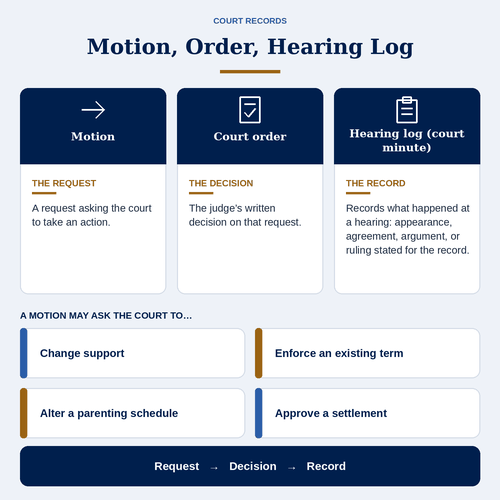
A motion asks the court to take a requested action, such as changing support, enforcing an existing term, altering a parenting schedule, or approving a settlement. A court order is the judge’s written decision on that request. A hearing log, sometimes called a court minute, records what happened during a hearing, such as the appearance, agreement, argument, or ruling stated for the record.
Docket Differs from a Hearing Log
A docket entry is a short index line that identifies a filing or court event. It may say “motion,” “hearing,” or “order entered” without setting out the full terms. The hearing log gives a more detailed account of what occurred during the hearing, but it may still omit attachments and exhibits. The written order or judgment states the approved legal terms and is the record to check when the wording of a settlement matters.
Judgment Differs from an Operative Order
A judgment formally resolves the claims in the case. An operative order may remain necessary to carry out custody schedules, payment duties, property terms, or other continuing requirements. A case can have a final judgment and several supporting orders. Reviewing the judgment without its related order can leave out the payment date, parenting schedule, or other terms needed to understand the result.
Active Cases, Final Judgments, and Modified Orders
An active case status means the case remains open in the Clerk’s system. It does not mean that every temporary order is still current. Temporary terms often end on a stated date or after a later event unless a judge extends them. A final judgment may close the main case while support, custody, or other continuing duties remain subject to later court action.
A request to change an existing order is often filed as a modification case with its own case number. Searching only the original divorce or custody case may miss the newest terms. Search by the parties’ names as well as the earlier case number, then compare the related cases and read the most recent order that changed the requested term.
Public Availability and Official Copies
The Seminole County Clerk is the official custodian of records and probate court records for the county’s courts. Many family case indexes and filed documents are available for public review, but public access does not mean every image can be viewed or downloaded without a charge. Access may differ by document type, party age, case status, court order, or a statutory privacy rule.
The Clerk’s Search System and Public Record Outlets
The official case-search system is the main starting point for a Seminole County family court records online lookup. It can locate a case by party name, family court case number, or filing date. Search results commonly show index facts and may provide a document image or purchase option. A search preview does not always include every filing, and the online catalog may not reproduce the exact content of a certified paper copy.
Copy requests can also be submitted by mail or handled in person through the Clerk’s office. The requester may seek an ordinary copy, a certified copy, or an electronic certification when that service is offered. Third-party record sites may help organize search results, but the Clerk’s system and request process control the official case record.
Public, Restricted, and Sealed Material
Florida court records are generally treated as public records, subject to specific exceptions and court orders. The access level can change from one filing to the next within the same case. A public docket, a redacted document, and a sealed document are three different states, so the search result label should be checked before a request is sent.
| Record Category | Common Public Treatment | Practical Step |
|---|---|---|
| Case index and docket | Often shows the case number, case title, filing date, court area, and listed events | Open the matching case and confirm the full case title |
| Petitions, motions, orders, and judgments | Images or copies may be available, depending on the filing and case status | Select the exact entry or submit a copy request for that document |
| Adoption records | Access is commonly limited because of the child’s privacy and state adoption rules | Ask the Clerk whether the record is available and whether the requester qualifies |
| Sealed or confidential files | The file may be hidden or show only a seal notation in the index | Provide proof of eligibility or a court order if required |
| Juvenile or minor-party records | Identifying and sensitive details may be protected or removed | Contact the Clerk for the permitted access method |
| Protective-order and domestic-violence files | The case may appear publicly while safety-related details are withheld | Ask the Clerk which filing details can be released |
| Financial records | Filed documents may be public while private account data is covered | Read the visible order and request a copy only through approved methods |
A redacted document remains a court record with some portions covered. A sealed document is not open for general public viewing. If the search result says “sealed,” “confidential,” or gives another restriction code, a public request alone may not change that status. The Clerk can explain the visible label and the process that applies to the file.
Requesting a Restricted Record
Ask the Clerk about the record’s status before sending a request. A case number and a valid government-issued photo identification are useful starting points for an in-person request. A person asking for sealed material may also need proof that they are a party, an attorney of record, an authorized agent, or another person recognized by the court. The accepted form of identification and proof of authority can differ by request, so confirm the requirements first.
For a mailed request, follow the current request form and include the case number, party name, document title, requested copy type, and required proof of identity or authority. Add payment only as directed by the Clerk. The clerk cannot remove a court-ordered seal merely because an online request was submitted. A person who needs access to a sealed file may need to seek a court order through the proper legal process.
Online, Mail, and In-Person Copy Requests
Choose the request method that matches the copy needed. An online file may be enough for viewing, while a certified copy may be needed for filing, a legal matter, or an official transaction. Each method has different proof, payment, and delivery steps.
| Request Method | What the Requester Supplies | Result |
|---|---|---|
| Online case search | Party name or case number, selected document, and payment when prompted | An electronic file or copy option if that document is offered in the portal |
| Mail request | Current request form, case details, requested document, required identification or authority, and payment | A clerk-prepared copy mailed after the request is reviewed |
| In-person request | Valid photo identification, case number or party name, and the type of copy requested | An available copy for pickup after the Clerk confirms the request |
For an in-person visit, provide the exact case number when possible and name each document needed. If several documents come from the same case, list them separately to reduce the chance of a missing item. For a mail request, follow the wording on the Clerk’s current form instead of relying on an old sample or an unverified third-party instruction.
Certified Copies, E-Certification, Fees, and Turnaround
A certified copy is a copy that the Clerk attests as a true copy of a court record. E-certification provides an electronic form of that assurance when the service and document are eligible. A downloaded image may lack certification if the portal does not state that it is certified. Check the product description and receipt before treating an electronic file as an official certified copy.
Typical fulfillment ranges from same-day pickup to three business days for mailed requests. Completion time can be longer when a file is sealed, traffic ticket records,archived, unusually large, missing payment details, or needs clerk review. A mailed request should not be treated as delivered to the requester until the tracking or receipt confirms shipment.
Record Accuracy and Missing File Resolution
Search results depend on matching names, case numbers, dates, and indexing. A correct legal name may not match a nickname, former name, misspelling, or shortened entry in an index. A case can also sit under a related case number. Reviewing several identifiers reduces the chance of opening the wrong family file.
Matching Party Names and Case Numbers
A family court case number is the strongest identifier when it is available. Copy every character, including any division prefix, suffix, or leading zero. If the number is unknown, search the full legal name shown on the case title rather than a shortened version. Related cases should be checked under each party because one person may have a divorce case, a custody modification, and a separate support case.
- Copy the family court case number directly from a prior filing or written notice.
- Compare the complete case title, including alternate names shown in the result.
- Search both parties when a case could be indexed under either name.
- Check separate modification, support, or protective-order cases tied to the same family.
- Match each docket event with its linked document before citing the event’s legal effect.
Recent Filings and Indexing Delays
A newly filed case may not appear at once because the Clerk must receive, process, and index the filing. Online images can also become available after the case index. A search performed soon after filing may show no match even though the case exists. Searching again after a short delay can help, but there is no fixed public posting period that applies to every filing.
If a hearing or judgment is approaching, contact the Clerk with the case number, exact case title, filing date, and scheduled hearing date. Avoid relying on a social-media post, third-party summary, or unconfirmed case number when a deadline is close. The court file remains the controlling source for scheduled events and filed orders.
Unlisted, Delayed, or Incorrect Records
A missing result does not always mean that no case was filed. The search category may be wrong, the name may be indexed under another form, the filing may still be processing, or the record may be restricted. Older files may also require a direct records request rather than appearing in the standard online index.
- Search the exact legal name, including former names that appeared on the case title.
- Try the correct family case category and a wider filing-date range.
- Look for related modification cases under the same parties.
- Ask the Clerk whether the file exists but is archived, unindexed, sealed, or handled through a records request.
- For a metadata or image error, retain the case number and request clerk review; changing an official court record may require action through the court.
Verifying the Legal Result
A docket line confirms that an event appears in the case index, but it may not state the complete terms of an agreement. Read the related hearing record, written order, and judgment together. An order that changes support, property division, or parenting time should also be checked against later modification filings.
When an online result conflicts with another source, ask the Clerk which filed record controls and request the needed copy. A certified copy provides the strongest confirmation when a person needs an official document for court, business, or personal use. This page explains public access and record procedures; it does not replace advice from a qualified attorney about a particular family-law matter.
Contact Details
Before requesting records, have the case number, party names, requested document titles, and desired copy type ready. Ask the Clerk to confirm accepted identification, payment methods, required forms, holiday hours, and whether an appointment is needed. Keep a copy of any request receipt or confirmation number for later follow-up.
Seminole County Clerk101 Bush Blvd
Sanford, FL 32773
Phone: (407) 665-4300
Office Hours: Monday through Friday, 8:00 AM to 4:30 PM
For a family court case lookup, certified copy, e-certification, sealed-record question, or missing-file review, use the Clerk’s official search portal and provide exact case details with the request. This produces a clearer record trail and reduces delays caused by incomplete names, missing identifiers, or uncertain document titles.
Frequently Asked Questions
Family Court Records in Seminole County give you a clear view of divorce, child custody, support, adoption and other family matters. Accessing these files helps you verify legal status, prepare for hearings, or keep personal records up to date. You can search online, visit the clerk’s office, or request copies by mail. The process is fast and the fees are modest, making it easy to stay informed about your case.
How can I search Seminole County family court records online?
Go to the official clerk website and click the “Search for a Court Case” link. Choose the “Family” filter, then type a first letter of the party’s last name or the exact case number. You can add the filing year to narrow results. The screen will list case numbers, parties, docket dates and recent orders. Click any entry to view a PDF of the docket or order. No registration is needed for basic searches, and each search costs $2 per year of record.
What information is included in Seminole County family court records?
A family court file shows the case number, names of the people involved, the type of case (like divorce or custody), filing date, and all filed documents. You will see motions, hearing notices, written orders, and the final judgment. The docket lists every activity with a date, so you can track progress. If a party requested a name change, the record will note the new name. All public details appear unless the court has sealed the file for privacy.
Are Seminole County family court records public?
Most family court files are open to the public under Florida’s public records law. Anyone can walk into the clerk’s office, use a public terminal, or search online. Records that involve minors, adoption, or are sealed by the court are not shown to the public. In those cases, only the parties or an attorney with a court order can see the details. If a record is marked confidential, you will receive a notice explaining the restriction.
What fees apply when I obtain Seminole County family court filings?
The clerk charges $2 for each year of record you search. A standard copy costs $1 per page for documents up to 14 × 8.5 inches. If you need a certified copy, add $2 per document. E‑Certification is $8 for the first page and $1 for each additional page. Mailing a copy adds the cost of a stamped envelope. Fees are paid by cash, credit card, or check at the clerk’s desk, and receipts are provided for every transaction.
I cannot find my Seminole County family court record online?
First, double‑check the spelling of the name and the case number. If the record is older than 1985, it may not be digitized. Try searching with the filing year or the party’s middle name. If the record still does not appear, visit the clerk’s office in person and ask a staff member to run a manual search. Bring a photo ID and any known details, such as the filing date or judge’s name. The clerk can guide you to the physical file or tell you why it is unavailable.