Genealogy Records for Seminole County illuminate family roots through birth, marriage, death, and land documents held by the county clerk and public library. Users can explore census listings, city directories, probate files, and military service papers to verify ancestor names and dates. The Seminole County genealogy records search portal offers searchable indexes by name, date, or record type, helping researchers build accurate family trees without visiting the office.
Seminole County genealogy research often begins with vital certificates, which the health department archives from 1917 onward. Deed and land records reveal property transfers that trace family moves, while probate and will files confirm inheritance links. Military drafts and pension files add details about service periods, and cemetery logs pinpoint burial sites. By cross‑referencing these sources, investigators can resolve conflicting dates and uncover missing ancestors in the county’s historical archives.
How to Search Genealogy Records
Genealogy Records for Seminole County include recorded deeds, dissolution of marriage,court cases, probate files, marriage and death certificates, and census sheets that place ancestors in Sanford, Longwood, Lake Mary, and Altamonte Springs. A records search tests a name, a date, and an address against documents created by the people who handled a family’s legal and personal affairs. The Seminole County Clerk holds the county’s official records and court files, while state offices and federal archives hold birth and death certificates, census schedules, military papers, and citizenship records. The purpose of a careful search is a trail another person can check, so every entry in a family tree should point to a named source with a date and a record number.
Official Search Portal: https://www.seminoleclerk.org
Steps to Search
- Open the Seminole County Clerk’s official site and choose the records search for Official Records. This covers recorded instruments such as deeds, mortgages, liens, judgments, and tax deeds filed with the county.
- Enter a surname in the name field, choose a document type, and set a date range. Searching the family name in both the grantor and grantee fields gives a fuller picture of who bought, sold, or mortgaged a parcel.
- Read each result for the recording date, document number, the parties, and the legal description. Early descriptions often name streets, lots, and nearby property owners, which anchors the family to a location.
- Note the document number before requesting a copy. The clerk uses that number to pull the recorded image and to prepare certified copies.
- Use the county’s court case search for probate, divorce, name-change, and guardianship matters. For birth and death certificates, contact the Seminole County Health Department or the Florida Department of Health, since the clerk does not hold those records.
The online records cover many decades, yet no single search reaches every record type, and some older files have never been indexed for the public. Official records and court files come from the clerk. Birth and death certificates come from Florida’s health offices, with statewide registration files kept from 1917 onward. Census schedules, military service papers, pension applications, and naturalization papers sit with the National Archives and with state archives. The county library’s local history room adds directories, newspapers, obituaries, and cemetery records that no single agency collects.
Historical Public Record Sources
Families rarely leave one clean trail, so a sound search draws on several record groups at once. Each group has a named custodian, and each answers a different question about an ancestor’s life. The table below shows where each group sits and what it can settle.
| Record group | Custodian or collection | What it can confirm |
|---|---|---|
| Deeds, mortgages, liens, judgments, and tax deeds | Seminole County Clerk, Official Records | Who bought, sold, or mortgaged property, when it transferred, and where the parcel sat |
| Wills, probate petitions, inventories, and guardianship files | Seminole County Clerk, Probate Court | Date of death, heirs, spouse, children, residences, and adults appointed for minors |
| Civil and criminal case files, including divorce decrees and name changes | Seminole County Clerk, County and Circuit Courts | Legal name changes, marriage details, creditor claims, and relatives who filed a case |
| Marriage licenses and certified copies | Seminole County Clerk, with statewide certificates held by Florida’s registration office | Marriage date, officiant, parents, and place of marriage |
| Birth and death certificates | Seminole County Health Department and the Florida Department of Health | Birth date, parents’ names, death date, cause of death, and burial place |
| Census schedules and state censuses | National Archives and Records Administration, plus Florida state archives | Household members, ages, occupations, property value, and places of birth |
| Military service, pension, and citizenship files | National Archives and Records Administration and Florida state archives | Service dates, enlistment residence, next of kin, and immigration dates |
| Directories, newspapers, obituaries, cemetery and funeral home records | Seminole County Library System, local newspapers, and funeral homes | Addresses, occupations, death notices, burial dates, and family news |
Birth, Death, and Marriage Certificates
Certificates give the cleanest proof of a birth, a marriage, or a death, and they are a first stop for many family histories. The Seminole County Health Department handles requests tied to the county, and the Florida Department of Health keeps the statewide registration files from 1917 onward, which makes it possible to order a certificate for an ancestor who later left Florida. The state office also publishes indexes, so an index hit can confirm that a file exists before anyone pays for a copy. The county’s health pages at https://www.seminolecountyfl.gov and the state office at https://www.floridamhealth.gov publish current request rules.
Marriage work splits in two. The clerk issues marriage licenses and keeps the county’s marriage records, and completed certificates filed with the state can be ordered through the state registration office. Birth and death certificates for recent decades carry access limits set by state law, and Florida may withhold a file from a requester who lacks a qualifying relationship. Certified copies carry a raised seal and a clerk’s signature, and most agencies asking for proof want that certified copy rather than a screen printout.
Deeds, Property, and Probate Files
Property records help trace family history by showing ownership, transfers, and asset details. Deeds identify buyers, sellers, transfer dates, payment amounts, and legal descriptions. Search both grantor and grantee names to find sales and mortgage records. Legal descriptions and parcel numbers can help locate properties on historical plat maps. Older maps may also reveal neighboring families and useful census connections.
Probate records provide details about heirs, beneficiaries, property, and guardianship after a death. Final court orders may include the date of death, last residence, and names of minor children. Older files may require an in-person or manual records request. The Seminole County Property Appraiser maintains separate ownership and sales histories for properties. Florida name-change decrees can also help explain spelling differences in family records. Comparing court, property, and probate records can help verify family history details.
Census, Voter, and Directory Records
Census schedules give the widest view of a household. Federal census forms record names, ages, birth months, occupations, property values, and immigration years, and they include a mother’s maiden name for most households from 1850 onward. The National Archives and Records Administration holds the federal census through 1950, and its site at https://www.archives.gov offers free access to the schedules and to the free Access to Archival Databases search used for many federal series. Florida kept state censuses in 1888, 1895, 1935, and 1945 that caught people between federal counts, and those sheets catch households that federal enumerators missed.
Enumeration district maps turn a rural address into a township, range, and section, and that description reaches land records and neighboring families in one step. City directories fill the years between censuses with addresses, occupations, and sometimes the business where a person worked. The Seminole County Library System holds directories and local history materials that can place a family on a street for a single year.
Military, Pension, and Citizenship Filings
Military paperwork repeats details that no other record carries. An enlistment record names a birthplace, the residence at enlistment, a next of kin, and sometimes a height or a birth date. Pension applications, granted to veterans who served before 1900, often include a marriage certificate, children’s names, and supporting affidavits from neighbors. Both service and pension files sit with the National Archives and Records Administration, and Florida’s state archives hold copied service records for many residents.
World War I draft registration cards remain mostly closed, so a draft card needs a different route than an enlistment record. Citizenship files follow a similar path: a declaration of intention, a petition for naturalization, and a final certificate often sit in federal court files at the National Archives, and Florida state archives hold copied naturalization records and divorce decree for county residents. These papers can separate two men with the same name and the same year of birth, and they can supply the arrival year and ship that a census only hints at.
Burial, Funeral, and Obituary Notices
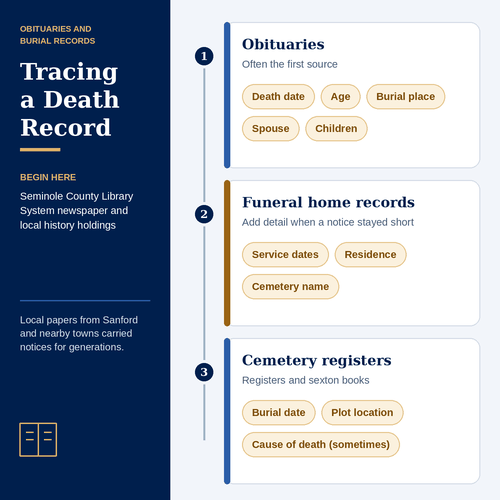
Obituaries are often the first source to state a death date, an age, a place of burial, and the names of a spouse and children. Local papers from Sanford and nearby towns carried notices for generations, and the Seminole County Library System’s newspaper and local history holdings are a good place to begin. Funeral home records add service dates, a residence, and the name of a cemetery when a notice stayed short. Cemetery registers and sexton books record burial dates, plot locations, and sometimes the cause of death.
Third-party cemetery websites can suggest a burial place or a full name, yet a transcription is a lead rather than proof. Check a headstone image, a funeral home record, or the death certificate before attaching a burial fact to a tree. Grave marker photos often settle a middle name, a birth year, or a surname spelled two ways.
Lineage Building and Verification
A family tree earns trust when each line rests on a document. Start with the person who lived longest and left the most records, then work outward. A probate file links a husband, a wife, and their children in one place, and a census household adds parents who lived under the same roof. Matching dates across two independent record groups keeps a guess from hardening into a claim.
Connecting Generations and Name Changes
Generation links come from shared details rather than from surnames alone. A marriage record that names both parents of a bride and a groom can tie two unrelated lines to one event. A probate inventory that lists a wedding gift can link a house to a family years later. A death certificate naming a child living in another county sends that child to another county’s records, and the same paper often names a second child who stayed home.
Name changes deserve their own file. Court-ordered changes, widowhood, remarriage, and spelling drift each produce a different trail. Keep a name table for every ancestor that lists the form used, the dates it appears, and the source. That habit prevents a maiden name from being confused with a married name and makes a variant spelling easy to explain to another researcher.
Tracking Ancestral Address Timelines
An address timeline turns scattered records into a route. Begin with the earliest record that names a street, then add each later address with its year. Census years, directory years, deed transfers, and tax rolls should agree with one another, and when they disagree, one document usually explains the gap. A missing stretch of a few years often means the family lived outside the county or in a newer subdivision, and a change in lot or block numbers can signal a move rather than a new owner.
Deeds often state that a party lives in a named county, which can show a move across a state line. Probate filings sometimes list a mailing address for a beneficiary. Those small details, collected year by year, turn a surname into a path through Sanford’s neighborhoods.
Cross-Referencing Independent Archives
No single agency holds a complete family file. The Florida Historical Society Collection at the University of Central Florida, at https://archives.library.ucf.edu, holds copies of Seminole County records from before the county formed in 1923, including court and certificate copies the county never received. Florida’s digital library, Florida Memory at https://www.floridamemory.com, holds newspaper images, photographs, and government publications with strong local coverage. The National Archives and Records Administration holds federal census sheets, military personnel files, pension applications, and naturalization papers. The Seminole County Library System at https://www.seminolecountylibrary.org adds directories, school yearbooks, club minutes, church registers, and photographs that no federal archive collects. School yearbooks and class photographs often name a child’s school, teacher, and street address, and local history research published by the Seminole County Historical Society can fill quiet gaps between official filings.
Telling Similar Name Matches Apart
Two people can share a name, a birth year, and a county. Comparing fixed details separates them before any data gets copied.
| Clue | What it tells you | Where to check it |
|---|---|---|
| Parents’ names | Often the strongest link between two family lines | Birth certificates, census schedules, marriage records |
| Spouse and marriage year | Separates two men with the same name | Marriage licenses and certificates, probate files |
| Exact date and place of birth | Ties a person to one family | Birth certificates, delayed birth filings |
| Address and occupation | Places a person in a household and a trade | Census schedules, city directories, deeds |
| Military unit or company | Identifies a specific soldier | Service and pension files at the National Archives |
| Death date and burial place | Closes a life record | Death certificates, cemetery registers, obituaries |
If two people share every one of those details, treat them as one person only after finding a document that links them, such as a will naming a child or a probate file naming a spouse.
Public Availability and File Requests
Most genealogy records in this county are open for viewing, though access differs by record type and by age. Florida’s public records law, found in Chapter 119 of the Florida Statutes, governs the county’s official records and court files, and fees cover copying and certification rather than the act of searching. Digitized images can save a trip, while courthouse storage, microfilm, and off-site repositories require a request.
County Archives and Public Libraries
The Seminole County Clerk maintains the official records and the court files for the county, and the clerk’s online tools reach back through decades of recorded instruments. The Seminole County Library System holds the local history collection, including directories, newspapers, yearbooks, and cemetery and funeral home records that support courthouse files. Library computers often give card holders free access to subscription genealogy databases, and the library lists current offerings on its site. Ask a librarian for local history holdings before visiting, since some material is stored off site and needs a call or a request slip.
Digitized and Physical Record Retrieval
Official Records images and probate case files can often be viewed online. Many older deed books and probate packets exist only as microfilm or scanned images, and staff may need to pull the file for you. A digitized image can fill in a detail that an index leaves out, such as a middle name written in a margin or the wording of a deed clause. For older volumes, check whether the online index reaches the years you need before spending time on repeated searches and divorce records, and note the book and page so a later request can be specific.
Requesting Restricted Historical Copies
A restricted historical copy is one that exists but cannot be released without a qualifying relationship or a court order. Recent birth and death certificates, sealed adoption and juvenile files, current voter registration records, and some draft registration cards fall into this group. The rules come from state law and federal policy, and each custodian explains its own process.
What Makes a Historical Record Restricted
Florida sets access rules for the state’s registration files, and federal policy governs military draft cards and some other federal series. A record can also be sealed by a court order, such as a closed adoption file or a juvenile case. Restrictions apply to the document rather than to the county, so a request sent to the wrong office ends without an answer. Ask each custodian which years it can release and what proof of relationship it accepts.
What to Send With a Copy Request
- Ask the right office. The clerk handles deeds, mortgages, probate files, marriage licenses, and court cases. The Seminole County Health Department handles local birth and death certificate requests, and the Florida Department of Health handles statewide certificate records.
- Give exact identifiers. A full name, a birth or death year, a spouse, a parent, and a known address locate a file faster than a surname alone.
- State the copy type you need. A certified copy carries the clerk’s seal and signature, and a plain copy or a printout serves most family tree work.
- Check current fees and request methods on the clerk’s official site or by phone. Copy costs and accepted payment types vary by record type and page count.
- Expect identification and a signature. Florida clerks require proof of identity and a signed request for certified copies of many record types.
- Ask about retrieval time for older files. Court and probate papers older than the digitized set may need a staff pull from storage.
Record Accuracy and Resolution
Most errors in a family tree come from a misread name, a copied date, or a record that was never checked against its source. A few habits prevent them: cite the source beside each fact, date every entry, and mark a claim as unproven until two sources agree. The sections below cover fixes for the most common problems.
Resolving Variant Spelling Differences
Names change across records for plain reasons. Handwriting, spelling, and pronunciation shape the form a clerk wrote. Some families used an English form of a name and kept the original at home, and census takers spelled names by ear. Marriage usually added a change, and a court order could add another. Rather than choosing one form, record each form with the source that used it.
| Variation | Likely cause | Test |
|---|---|---|
| One surname in a deed and another in a census | Marriage, remarriage, or a court name change | Look for a marriage record or a name-change case |
| A first name appears as an initial | The clerk or enumerator wrote less than the full name | Compare with signatures, probate papers, and obituaries |
| A nickname on a census and a formal name elsewhere | The family used both in daily life | Check service, school, and certificate records |
| An Anglicized spelling of a family name | A family choice at arrival or in daily use | Compare arrival and naturalization papers |
| Spelling shifts between census years | The enumerator heard the name differently | Compare neighbors who appear in both years |
Unindexed and Undigitized Archives
Some documents exist only as paper in a courthouse box, a microfilm reel, or a scanned image with no index entry. When a name search fails, try the spelling from the person’s own handwriting, search a spouse or a sibling, and widen the date range by a few years. For courthouse files, staff can search indexes that do not appear online. A partial answer naming a document number, book, and page often helps more than a silent search, so write down each place you checked even when nothing turned up.
Records that predate 1923 often exist as copies rather than in the county’s own books. The Florida Historical Society Collection at the University of Central Florida and Florida’s state archives both hold copied filings from the years before Seminole County became a separate jurisdiction. County boundary changes also matter: a family from the northern part of present-day Seminole County may have filed in Orange County or Volusia County before 1923, and the clerk’s index may carry a cross-reference for those years.
Missing Ancestral File Resolution
When a file cannot be found, work through four possibilities in order. The person may have been born or married before the county existed, or outside Florida, so a birth or marriage file would sit with another state or country. The record may exist under a different name form, or it may be filed under a spouse, a parent, or a business owner. The document may sit in a collection that has never been indexed for the public, which happens often with court packets from the middle of the twentieth century. A final cause is access limits, since recent certificates and sealed files stay closed.
Record what you searched, with dates and terms, so the next attempt starts from a known point. When a file stays out of reach, cite the collection and the range of years checked. Another researcher, or a later edition of the same index, may find what a first pass missed.
Contact Details
The Seminole County Clerk handles official records, court cases, probate files, and marriage records for the county. Ask staff for the correct search category, the document number of a record you located, and the current fee for a copy. Staff can also tell you which older records require a request and which are available online. Confirm current portal addresses, fees, and access rules on each agency’s site before ordering, since copy policies and online tools change over time.
| Contact point | Details |
|---|---|
| Office | Seminole County Clerk, 101 Bush Blvd, Sanford, FL 32773 |
| Phone | (407) 665-4300 |
| Office hours | Monday through Friday, 8:00 AM to 4:30 PM |
| Official website | https://www.seminoleclerk.org |
| Best first questions | Which office holds a record type, whether an index reaches a given year, and how to request a certified copy |
For birth and death certificates, contact the Seminole County Health Department or the Florida Department of Health. For census sheets, military files, pension applications, and citizenship papers, start with the National Archives and Records Administration. For directories, newspapers, yearbooks, and local history, start with the Seminole County Library System. Use the clerk’s search for property, probate, and court records, and keep a source list as you work. A record that names a source, a date, and a number will hold up in any family tree.
Frequently Asked Questions
Finding family history in Seminole County means working with many record types. The county clerk holds deeds, probate files, marriage and death certificates, while the state keeps birth and death indexes. Online portals let you search by name, date, or address, and public libraries offer digitized collections. Knowing which office to contact saves time, and using the correct search terms brings faster results. Below are common questions and clear steps to help you locate the records you need for your family tree.
How can I search Seminole County genealogy records online?
Start at the official portal https://www.seminoleclerk.org. Enter the ancestor’s full name, then add a birth year or address to narrow results. Use the drop‑down menus to select record type—deeds, marriage, probate, or census. After clicking “Search,” review the list and click any record title to view a PDF or image. If the record is not online, note the case number and call (407) 665‑4300 for a copy request. This method works for most documents created after 1910.
What types of Genealogy Records are available in Seminole County?
Seminole County keeps land deeds, court cases, probate files, marriage and death certificates, and census sheets. The clerk’s office also stores birth indexes from 1917 onward, school records, voter registrations, and cemetery logs. Library partners provide newspaper archives, city directories, and military service files. Each collection reveals details such as parents’ names, occupations, and residence addresses, which help link generations together. Checking multiple sources can fill gaps left by missing or damaged paperwork.
Where can I find Seminole County vital records online?
Visit the Florida Bureau of Vital Statistics website for birth and death indexes dating back to 1917. For marriage records after 1927, use the Seminole County Recording Department’s online search tool. Both sites let you filter by year and location, then download a certified copy for a fee. If the record is not digitized, the clerk’s office at 101 Bush Blvd, Sanford, can retrieve a paper copy when you provide the ancestor’s name and approximate date.
How do I locate a 1918 birth record for an ancestor in Sanford, FL?
First, check the Florida Birth Index (1917‑1935) on the state’s vital records portal. Enter the ancestor’s name and choose “Seminole County” as the location. If the entry appears, note the record number and request a certified copy by mail or phone at (407) 665‑4340. If the index shows no match, contact the Seminole County Library’s genealogy desk; they may have a microfilm copy. Provide the full name, birth date, and parents’ names to speed the search.
I can’t find my family’s marriage certificate in Seminole County?
Begin with the Marriage Index (1927‑2001) on the county’s website. Search using both spouses’ full names and narrow by year. If the certificate is missing, call the Recording Department at (407) 665‑4300 and ask if the record is stored off‑line. They may need a written request with the marriage date and location. As a backup, check the local library’s historic newspaper collection for wedding announcements, which often list the exact date and venue.